As the usual mid-summer quietude arrived, activity around lumber sales
remained quite robust.
Transportation constraints loomed large, so most of this activity was
focussed on wrangling delivery. Due to delays sourcing trucks and even more
so rail cars, sawmills actually had notable supply in their yards waiting to
go out to impatient customers. This situation does not appear to be getting
resolved soon.
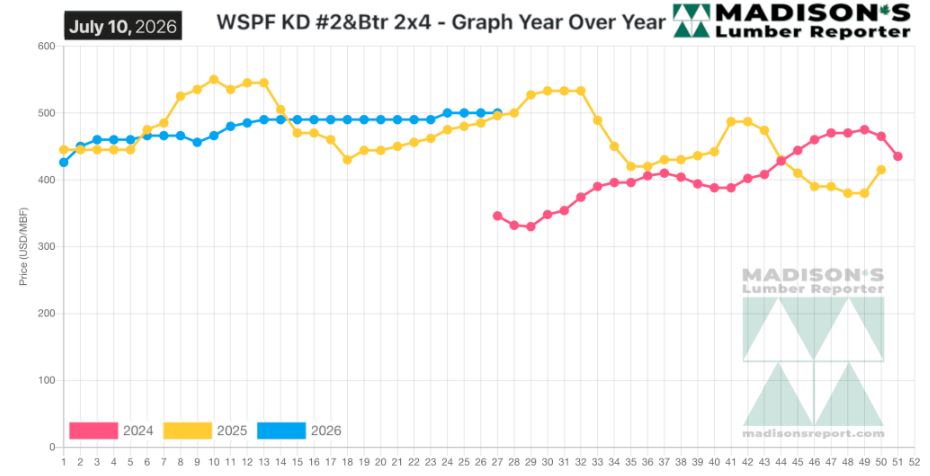
Prices of benchmark lumber item WSPF 2×4 hit almost the exact same level as
one year ago, providing indication of stability in the year-over-year trend
line. The numbers indicate that industry as arrived at the new bottom for
lumber prices. The strict discipline exercised by sawmills over the past
more
than two years, to keep manufacturing volumes in line with muted demand,
indicates that — going forward — prices for most solid wood commodities will
either be flat or will go up.
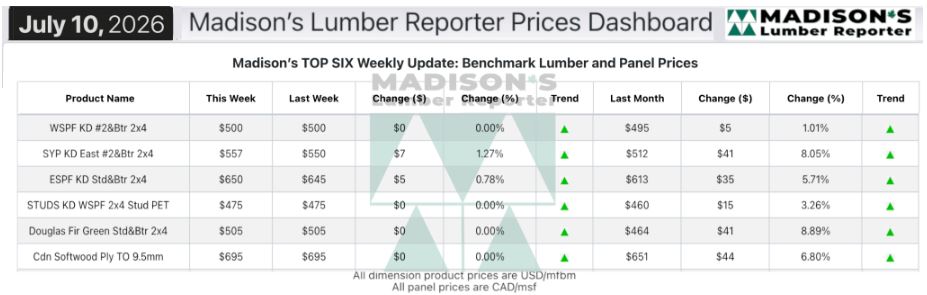
In the week ending July 10, 2026, the price of benchmark softwood lumber
item Western Spruce-Pine-Fir 2×4 #2&Btr KD (RL) was US$500 mfbm. This was
flat from the previous week, said weekly forest products industry price
guide newsletter Madison’s Lumber Reporter.
That week’s price was up +$5, or +1%, from one month ago when it was $495.
Compared to the same week last year, when it was us$496 mfbm, the price of
western spruce-pine-fir 2×4 #2&btr kd (rl) for the week ending July 10, 2026
was up +$4, or +1%.
Compared to two years ago when it was $346, that week’s price was up +$154,
or +45%.
Most standard dimension lumber commodities gained some ground with
prices due to ongoing limited overall supply, while Hemlock/Douglas fir and
plywood prices remained firm.
 KEY TAKE-AWAYS:
• Western-SPF producers in the US were nominally in the driver’s seat,
maintaining sawmill order files at two- to four-weeks.
• Regional mills showed more short-term availability than national outfits.
• Availability of Western-SPF in Canada continued to be limited across the
board.
• Transportation constraints have not improved in many weeks.
• Many Eastern-SPF producers in Canada were in the midst of two-week summer
shutdowns.
• Most sales were as quick truck business; buyers covered their needs
through the distribution network.
• Availability of most Southern Yellow Pine commodities was spotty.
• Buyers in the US south found success only if they showed considerable
flexibility with delivery timelines.
• Due to transportation constraints, lead times were into late July or early
August.
• Eastern Stocking Wholesalers reported that Douglas Fir material was
staying on the West Coast, leading to mounting shortages in the tri-state
area.
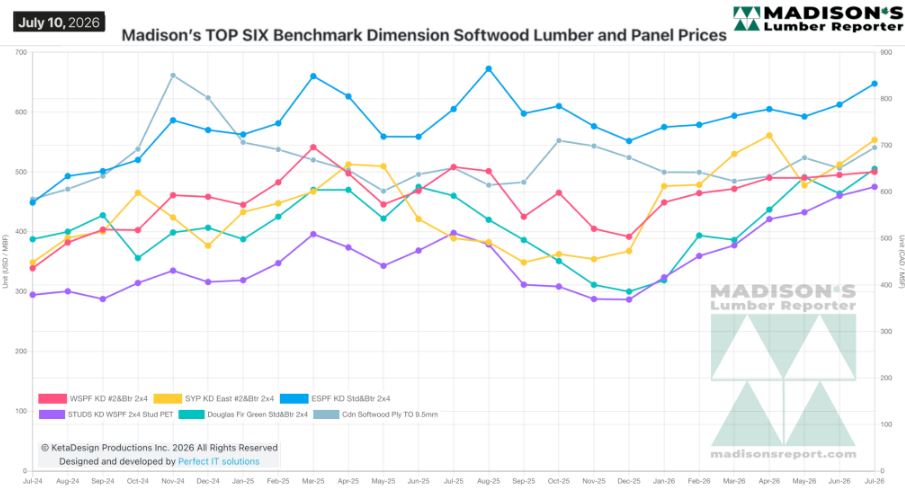
MADISON’S BENCHMARK TOP-SIX SOFTWOOD LUMBER AND PANEL PRICES: MONTHLY
AVERAGES
Source: madisonsreport.com
More Reports:


